Connected Pokémon card art and how to arrange it
Connected artOctober 13, 2026
Connected scene or connected story?
Some Pokémon cards join into one picture. Others follow the same characters through time. Both make lovely pages, but only the first needs an exact position for the edges to line up.
A family growing up
Ralts, Kirlia, and Gardevoir ex follow the same family through different years of their life.
Four seasons
Deerling and Sawsbuck connect into one wide landscape. Center the pair instead of stretching it.
Deerling 165 and Sawsbuck 166 from Temporal Forces form a landscape when placed side by side. Ralts 211, Kirlia 212, and Gardevoir ex 245 from Scarlet and Violet tell a family story in that order; they are not one edge-to-edge panorama.
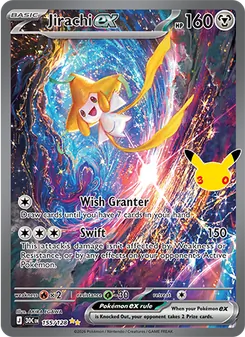
The 30th Celebration Meowth trio
Three Meowths, three city scenes
Meowth, Alolan Meowth and Galarian Meowth share OKUBO's city scenes in 30th Celebration. Keep the trio in one row; these are related scenes, not an edge-to-edge panorama.
The same three Meowth forms appear around these scenes. Collect the trio as one row, or put the regular cards above their illustration versions. The 30th Celebration card list has both.
The nine-card Crown Zenith puzzle
Read the rows left to right: GG26-GG28, GG29-GG31, GG32-GG34. Pikachu sits in the center. The Galarian Gallery card list shows the rest of the collection.
Choose the grid around the artwork
A 9-pocket page fits the puzzle without interruption. A 12-pocket page has an extra column; keep the puzzle in a 3 by 3 block and use the side column for three related cards or separate art inserts. Do not continue the puzzle into four-card rows.
A two-card panorama suits two neighboring pockets in a 4-column page. On a 9-pocket page, use the third pocket for a companion card or a deliberate gap.
Make a connected-art binder
Start one empty page and search Cards by Pokémon and set. Put each story in its own row or spread, with a spare page for the next group. Cards that simply share a mood can go in a separate full-art section; they do not have to pretend to be a puzzle.